A shutdown ritual that survives a real week
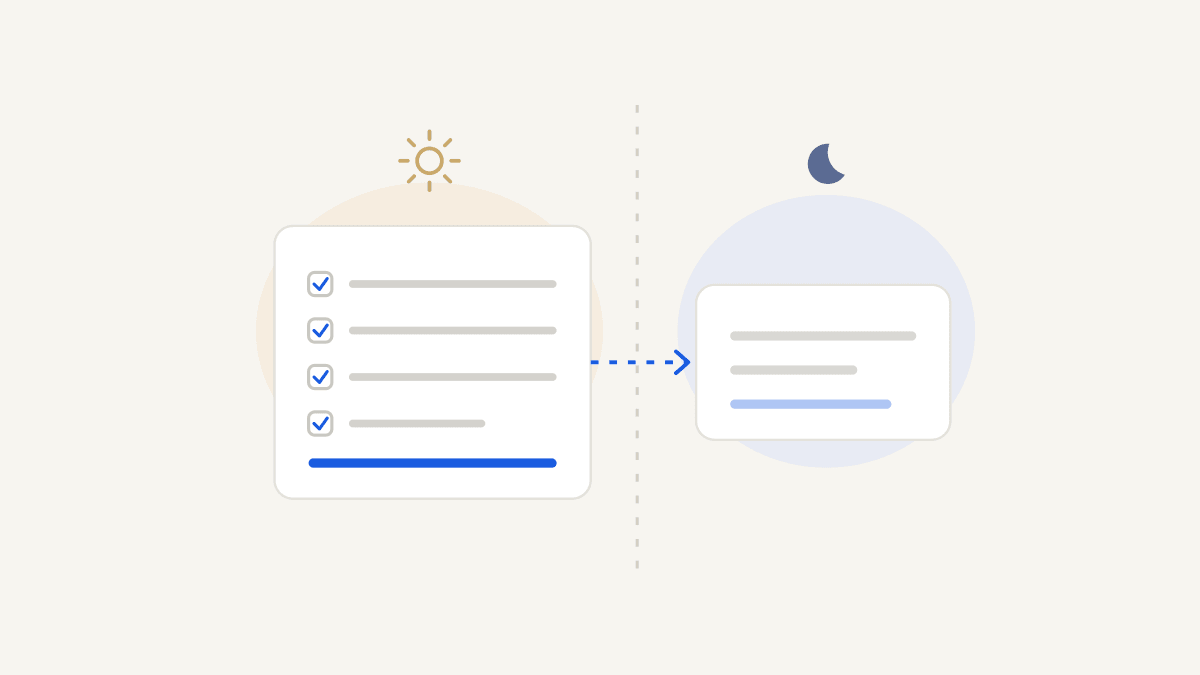
Most shutdown rituals fail the same way. They work beautifully for eleven days, and then you have a bad Thursday — the kind where you’re still mid-thought at 6:40pm and someone is asking about dinner — and you skip it. And the day you skip it is, of course, exactly the day it would have earned its keep.
So the design constraint isn’t “thorough.” It’s “survives the bad Thursday.” Everything below is shaped by that.
This is one practical application of mental offloading: making unfinished work safe to leave by giving it a credible return point.
Why writing it down works at all
There’s a specific piece of research worth knowing here, because it explains why this isn’t just tidiness.
Masicampo and Baumeister looked at what happens to the mental pull of an unfinished goal. The Zeigarnik effect says incomplete tasks stay unusually accessible in memory — they keep surfacing. What they found is that this intrusiveness drops substantially once you make a specific plan for the task. Not once you complete it. Once you plan it.
The task stays undone. Your head lets go of it anyway.
That’s the mechanism the whole ritual runs on, and it tells you exactly what the ritual has to produce. Listing what’s unfinished is not enough — a bare list is just an inventory of open loops, and it can make the evening worse rather than better. What quiets a thing is a credible answer to “so what happens to this.”
It also tells you what “credible” has to mean: specific enough that you believe it. “Deal with the contract tomorrow” won’t do it. “Open the contract at 9, start with clause 4” will.
The five prompts
Six minutes, before the laptop closes. Written, not thought.
1. What’s still open? Everything with a claim on you. Not a full task list — the things that would otherwise surface at 9pm. Usually three to six items.
2. What changed today? The state deltas. “Legal came back with two objections, neither is a blocker.” This is the line that saves you tomorrow, because it’s the part that decays fastest and is invisible in any task manager.
3. What’s unresolved? The decisions you didn’t make. Name them explicitly. Undeclared decisions are what actually keeps people awake — not workload, but a choice being silently deferred while some part of you keeps trying to make it.
4. What’s tomorrow’s one priority? One. If you write three, you’ve written zero, and tomorrow-morning-you will spend the first twenty minutes choosing. Choosing is much easier now, with today’s context, than it will be cold.
5. What’s the first action? Physical, specific, startable without thinking. “Open last quarter’s model and update the churn assumption.” Not “work on the forecast.”
That last one does more work than the other four combined. Tomorrow morning doesn’t need a plan; it needs a way in that doesn’t require a decision.
Making it survive
Anchor it to the laptop, not the clock. “5:30pm” fails the moment the day runs long, which is the day you need it. “Before the lid closes” holds.
Six minutes, hard stop. A ritual that expands into a nightly review will get skipped within a fortnight. If something needs longer, it’s work, and it belongs in the workday.
Write it where tomorrow-morning-you will actually collide with it. This is where most attempts quietly die. A note in an app you don’t open at 9am doesn’t resurface, and after two or three of those your brain correctly concludes that offloading is unsafe and goes back to holding everything itself. The return matters as much as the capture.
Do it badly rather than not at all. Two lines on the bad Thursday beats a perfect entry on the good Tuesday, because the ritual’s value is mostly in never breaking the chain of trust.
What it looks like
An actual one, lightly redacted:
Still open: vendor contract review, hiring loop debrief, Q3 forecast revision. Changed today: legal came back with two objections on the contract — neither is a blocker. Second candidate’s references came back strong. Unresolved: whether to extend an offer to the second candidate before the first one answers. Tomorrow’s priority: forecast revision. Finance needs it before Friday. First action: open last quarter’s model, update the churn assumption. Do not start with email.
Ninety seconds to write. The “do not start with email” is there because I know myself.
Two honest caveats
This is not a sleep intervention. If you can’t switch off because of anxiety, or because you’re carrying more than is actually possible, a shutdown ritual will give you a very clear-eyed view of an unmanageable situation. That’s better than a vague dread, and it’s genuinely useful information. It is not a fix, and I’d be wary of anyone selling it as one.
A shutdown ritual is not the only boundary that matters. The end of the day is just the most visible one. The same problem shows up mid-afternoon when you move between projects, or when you step out of work for a school run and the work follows you through it. Those transitions get almost no deliberate handling, and they happen far more often than 6pm does.
The end of the day is a good place to start, though. It’s the one boundary that arrives at a predictable time, which makes it the easiest place to build the habit before you try to apply it to the boundaries that ambush you.
I’m working on a version of this that carries the handoff into the next morning rather than leaving it in a file. The evening reset page has more on where that’s going, and there’s an early-access list if you want to shape it.