What mental offloading actually is
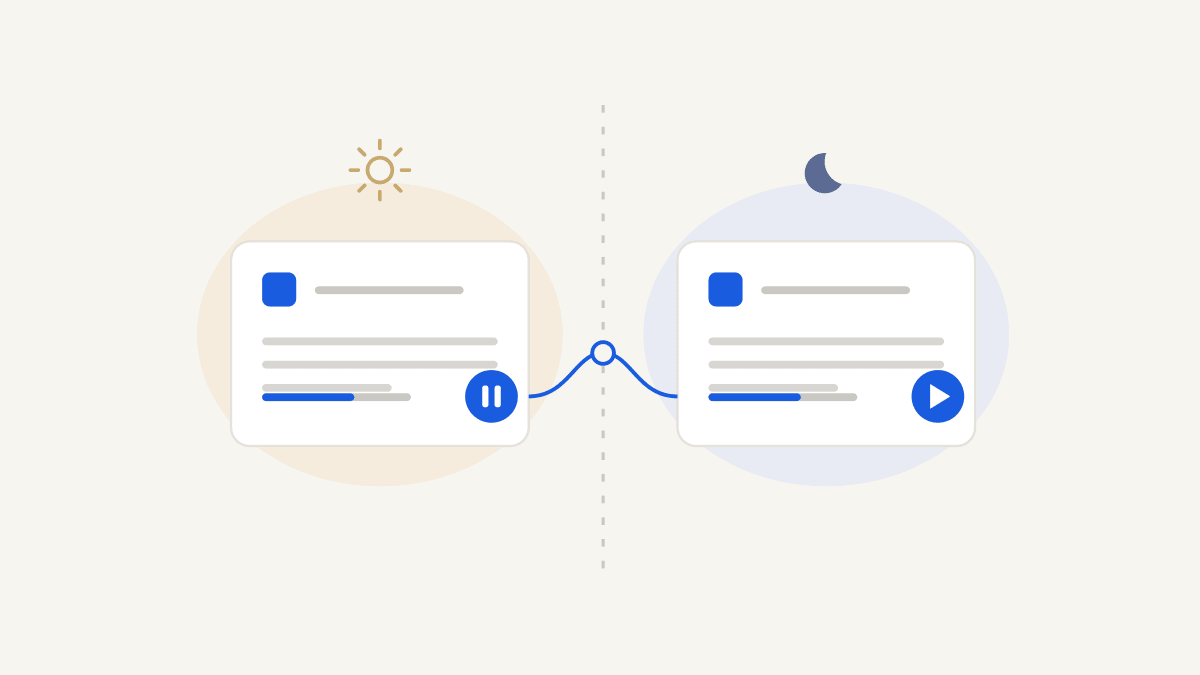
Mental offloading is the practice of moving something you are currently holding in your head into somewhere outside it, so your head no longer has to hold it.
That sounds obvious enough to be useless. Writing a shopping list is mental offloading. So is setting an alarm, or putting your keys by the door so you don’t forget them. The reason it is worth a name is that most of us do it well for facts and badly for work in progress, and the second one is where the cost lives.
The research version
Psychologists call this cognitive offloading, and the useful definition comes from Evan Risko and Sam Gilbert’s review of the field: taking a physical action in the world in order to reduce the mental effort a task demands. Tilting your head to read rotated text is offloading. So is using your fingers to count.
A few findings from that literature are worth knowing:
People offload more when they trust their memory less. Research on confidence-guided cognitive offloading found that the decision to set an external reminder tracks how confident you feel about remembering, independently of how well you actually perform. That matters because confidence is not always well calibrated. You will happily carry six things in your head on a good morning and drop four of them by 3pm.
Offloading generally improves performance. When people are allowed to set reminders, they do better on the task at hand. This is not a moral failing or a sign of a weak memory. It is what external tools are for.
Unfinished things behave differently from finished things. The Zeigarnik effect — the observation that incomplete tasks stay more accessible in memory than completed ones — is old, contested in its details, and still directionally useful. Something you have not finished keeps a claim on you.
The most practically interesting result I have come across is from Masicampo and Baumeister, who found that the intrusive pull of an unfinished goal drops substantially once you make a specific plan for it. Not once you finish it. Once you plan it. The task remains undone, and your head lets go of it anyway.
That result is the whole idea in one line. The thing your brain wants is not completion. It is a credible answer to “what happens to this now.”
Where most systems stop
Almost every tool I’ve used is built to offload one of two things:
- Facts. Notes, documents, wikis, bookmarks. Good at storing what you knew.
- Commitments. Task managers, calendars, reminders. Good at storing what you owe.
Neither one stores the thing that is expensive to lose, which is the working state of a task in progress. That includes:
- what you were actually trying to achieve, as opposed to the ticket title
- where the work currently stands
- which decisions are already settled, and why
- what is still unresolved
- what you were about to try next
A task manager will faithfully tell you tomorrow that “renegotiate the logistics contract” is still open. It will not tell you that they had already conceded on term length, that you’d ruled out splitting the contract across two vendors, or that the only live question left is whether procurement will wear a higher unit price. So you rebuild all of that, and rebuilding it is the tax.
The difference between a note and a handoff
I’ve started thinking of it as the difference between writing a note and writing a handoff.
A note is for storage. It is addressed to nobody in particular and optimised for being findable later.
A handoff is addressed to a specific person at a specific moment: you, tomorrow morning, with no memory of today. It is optimised for resumption. The test of a good handoff is not whether it captured everything. It is whether the person reading it can start working within a minute of finishing it.
That reframing changes what you write down. You stop summarising what happened and start writing the thing your future self will actually need first.
The boundary is a context, not a task
It’s worth being precise about when this matters, because “switching tasks” undersells it. Nobody needs a handoff to move from one email to the next.
The moments that cost you are the ones where you swap out an entire context:
- moving from one project to another, where the goal, the constraints and the cast of characters all change
- being pulled out of work into something personal — a school run, an errand, a call you have to take at home
- coming back to work after that, several hours later, cold
The second and third are the ones I see people account for least. A switch between two work projects at least feels like work, so you brace for it. Leaving a half-finished piece of work to go and do something domestic doesn’t feel like a professional transition at all, which is exactly why nothing gets written down — and why the work then follows you through the chore, half-present for both.
The size of the gap is what determines the cost, and the gap is a function of how completely the context got replaced, not how long you were away.
The five lines
Here’s the shape I keep coming back to, whichever boundary I’m crossing:
- Goal — what I am actually trying to reach, in a sentence
- Where it stands — the true current state, not the optimistic one
- What matters — the constraint or decision that must not be re-litigated
- Still open — the question I have not answered
- Next move — the single specific action to start with
Five lines. Under a minute if the work is still fresh, which is exactly why it has to be written before you leave, not after you come back.
Where mental offloading stops being useful
Three honest limits.
It does not reduce your workload. You still have the same number of things to do. What changes is how much of them you carry between sessions. If the underlying problem is that you have committed to more than is possible, offloading will make you a calmer person with an accurate picture of an impossible workload. That is genuinely better than the alternative, but it is not the same as fixing it.
It does not survive a system you don’t trust. The whole mechanism depends on believing the thing will come back to you. If you have parked ideas in three different apps and lost them, your brain has learned that offloading is unsafe and will keep holding things regardless of what you write down. Trust is the load-bearing part, and it is built by the handoff actually resurfacing, not by the capture step.
It is not a substitute for finishing things. Parking is not progress. A handoff that gets rewritten every day for two weeks is telling you something about the task, and the answer is usually to drop it or do it, not to describe it more carefully.
Why I keep coming back to it
I move between architecture work, product experiments, calls, and whatever the evening actually holds. The hardest part of that has never been remembering that a project exists — the task list is not the problem. It is recovering the exact position from which useful work can continue.
The gap between “I know I was working on this” and “I know what to do next” is where my days leak, and it is the specific gap I’m trying to close.
The practical versions are more specific: the real cost of switching projects, a shutdown ritual that survives a real week, and why a saved song idea can still become unusable.
I’m building something around this idea and I’m still at the stage where the shape can change. Three versions of the boundary seem to matter most: moving between projects, or out of work and back again, closing the day with things still open, and setting down a creative idea you can’t develop yet.
If one of those is a live problem for you, I’d rather hear about it than guess.